We are making some major changes in our farm to keep the farm profitable and sustainable, and to reduce our work load. We are closing our farm store and self-service egg refrigerator at the end of the year. We have frozen chickens, convenience packs, honey, Everyday Miracles Salve and lamb available as long as supplies last. Next year we will be selling strictly wholesale to stores. We will continue to produce our pasture raised eggs and sell them in the stores that are currently carrying them and will likely add a few new stores.
Next year we will not be raising broiler chickens or turkeys, and we will not have eggs or other products for sale here at the farm.
Earlier this summer we felt that God might be directing us to stop raising broilers and turkeys and stop selling retail here on the farm. We decided to wait until Thanksgiving to make the final decision. As time went along we discovered more and more reasons why we should stop raising broilers and turkeys and close the farm store. We will not list them all, but the main reason is to reduce our work load. Farming is hard work and requires long hours. It is time to make some changes. We do not want our children to get discouraged and feel like a sign I saw recently which said: “Because of the heavy work load, the light at the end of the tunnel has been turned off!”

We have felt exhausted like this more than once this year!
Much of “Sustainable Agriculture” is not Profitable Or Sustainable
In explaining why we are closing our on-farm store, I think it is important to explain where agriculture is financially here in America – how we got where we are, and how we as sustainable farmers have been trying to make things work financially.
In a speech given on Oct. 21, 2007, former Federal Reserve chairman Alan Greenspan explained that the Federal Reserve has been involved in financial engineering in the U.S. using a technique called “Creative Destruction” to move people out of lower paying jobs such as farming, manufacturing, and the textile industry into higher paying jobs such as health care and education. The result has been that farming, which years ago was a profitable business enterprise, has become unprofitable for most farms. (See my article on Creative Destruction in the May 2008 newsletter at: https://www.jehovahjirehfarm.com/articles/2008/05/12/creative-destruction-related-to-farms/)
According to the USDA, most farms in the United States earn ALL THEIR HOUSEHOLD INCOME FROM OFF-FARM SOURCES! The USDA’s projection is that the median farm income for 2015 will be -$1,504! In other words, most farms are losing money, not making money. (http://www.ers.usda.gov/topics/farm-economy/farm-sector-income-finances/highlights-from-the-2015-farm-income-forecast.aspx)
Let that sink in. Do you know of any other profession where most of the businesses are not making any money for labor even in the good years? Most of the farmers in America are working for free. Actually, with a farm loss, many are paying to work for “free”. This is ridiculous and is not sustainable. Anything that is not sustainable will sooner or later come to an end. And then where will the food come from? Think of that the next time you see the bumper sticker – “No Farms, No Food”. The thing that so far has kept farmers going is their passion for farming. They love to farm and will do whatever is possible to keep on farming, even if it means farming for free. But sooner or later, the reality of what they are doing will dawn on them, or some event will happen that will force them to stop farming.
As our family evaluated whether we should continue to raise broilers and turkeys and operate our farm store, we realized that something had taken place in the sustainable agriculture movement that we did not see before. Since most farms were not really making money from farming, we were encouraged by people like Joel Salatin, sustainable agriculture seminar speakers, and county extension agents to sell our products directly to the public through farmers markets, CSA’s, and on-farm stores so that we could get the retail dollar for our products. That worked. It enabled farmers to get some money to put toward their living expenses. Other farms have added agritourism to keep their farm going.
What we as farmers did not fully realize is that by selling retail, we were actually adding a new business enterprise to our farm. When a store sells a product at retail price, they have a lot of labor, overhead, and other costs that go along with selling the product. The difference between the wholesale price and the retail price is not free money as many farmers tend to look at it. It takes a lot of time, planning, marketing, and preparation behind the scenes to sell directly to the consumer. What is happening is that the farmer is working for free on the farm to produce food for others, and then working a second job in retail (selling at farmer’s markets, a CSA, or on-farm store) which is actually providing their income.
Selling retail makes the farmer’s work load greater for another reason. The farmer has to have a variety of products to sell if he/she is going to attract customers to their farm market stand, CSA, or farm store. If a farmer had only one product, such as eggs or one kind of tomatoes, they would not sell very much. Each product or vegetable takes time to produce. Because of the limited retail market at each location, the farmer can’t take advantage of the economy of scale like large farms do in reducing the production cost per item. In a Weston A Price, Wise Traditions Magazine article titled “The Real Cost of Real Food”, one man shared how that with his 100 hens he would have to get $11.52 a dozen for his eggs in order to get paid $10 an hour to produce them. (http://www.westonaprice.org/health-topics/the-real-cost-of-real-food/) Because of the need for a variety of products, some sustainable farmers are producing products at a loss in order to have products to draw customers to their farm or farmer’s market stand. Those loss-leader products represent a lot of labor over the course of a year that never gets paid for, and means that the farmer has to work more even more hours at something that does make money.
Selling retail works, but we have been hearing from many sustainable farmers in the last several months how exhausted they are. They feel like they can never get everything done that needs to be done. Sheri Salatin, who with her husband Daniel (Joel Salatin’s son) manages Polyface Farm in Virginia, stated several weeks ago in a blog post: “I’ve been way too busy this year and to be brutally honest, if every year is going to be this hard, I’m ready to quit. No it’s not been a bad year. No, there was nothing tragic. I’m almost embarrassed to admit, because I know many out there who have had some major health concerns or lost loved ones this year. It has just been one of those years where… Let’s see, how can I explain it? Well, I have a list of things to get done every day and if I don’t plan my day and run it ‘just so’ not everything that I needed to get done that day will get done. And nothing on the list is optional for another day.” (http://polyfacehenhouse.com/2015/11/farm-wife-friday-a-farm-table-discussion/)
In the comments section, almost every response is from a farm woman who is feeling much the same way as Sheri.
What I have shared with you about what is happening in sustainable agriculture is negative and discouraging. I share it to help you understand why we feel it is important to close our retail sales and the extra work load that it creates. But we are not feeling negative or discouraged about our farm. Instead, we are looking forward to the future and staying sustainable. Selling eggs wholesale to stores is a profitable enterprise for us. We are getting paid for our farm labor. The name Jehovah-Jireh means “the Lord will provide”. We feel that one of the ways God has provided for us is by showing us how to make a living from our farm.
We are moving forward. We recently converted our pullet raising shelter into another hen shelter and bought some more organic hens. We are still caring for the same number of birds, and the labor is much the same, but the hens are producing an income whereas raising baby egg layers did not produce an income. The increase in egg income should more than offset the loss of on-farm sales. Our family feels like the light at the end of the tunnel has suddenly gotten brighter. We are looking forward to a break from a very, very busy summer and fall. Closing the farm store and some of our other farm enterprises will enable us to give more attention to the hens so that we can hopefully provide even better eggs for you. We will miss seeing those of you that come to the farm, but you will still be able to buy our eggs and BARC pet food in the stores. We plan to continue to keep in touch with the farm newsletter, and will probably send it out about three or four times a year.
You may also like to read:
The End of Organic Farming Might be Sooner Than We Thought by Cara Parks, Oct. 12, 2015 http://www.refinery29.com/2015/10/94908/small-organic-farm-businesses-unsustainable-agriculture
I’m Not Sorry — A November 2015 blog post by Shannon Hayes, pasture based farmer and author of The Grassfed Gourmet Cookbook: Healthy Eating and Good Living with Pasture-raised Foods http://theradicalhomemaker.net/tuesday-post/i-am-not-sorry/
Some local farms that use organic feed and raise broilers on pasture:
Rights of Man Farm, Ijamsville, Md. http://www.rightsofmanfarm.com/index.html
Nick’s Organic Farm, Buckeystown, Md. and Potomac, Md http://nicksorganicfarm.com/
Dayspring Farm, Middleburg, Va http://dayspringfarmva.com/

This fall we are adding a “Winter Garden” to each of our hen shelters. Previous to this, at the south end of the hen shelters there was a fenced area with wood chips on the ground which we called the picnic area. It was a place where we could confine the hens when the pasture was too wet, there was snow on the ground, or the pasture conditions did not permit the hens to be on the pasture that day. It is an important management tool to keep the pastures from being destroyed. By covering the picnic area with a greenhouse, the hens can now enjoy dry bedding and the heat of the greenhouse on those cold winter days in January and February. In the Spring the plastic on the sides will be rolled up and the roof covered with white plastic giving them a large open air pavilion. Hens, like us, do not like the hot sun in the middle of a summer day. It will provide more shade for them to lounge around in while they wait for the cool of evening to come so they can range the pastures before bedtime.
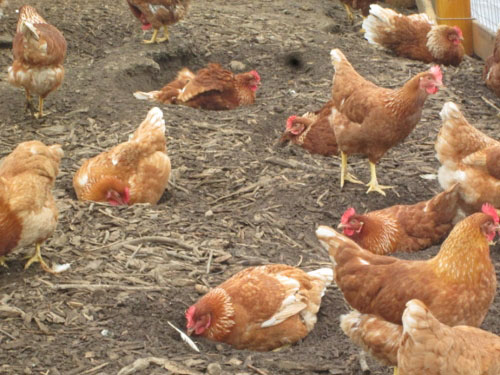
The hens are already enjoying dust bathing, scratching and just being in the Winter Gardens.
 frozen pipes, and no heat for the first three weeks, the work rapidly progressed. God sent a number of people at the right times to help us repair and clean up the house. We also saw God’s provision and answers to prayer in providing incredible deals on supplies and in providing many things free of cost.


